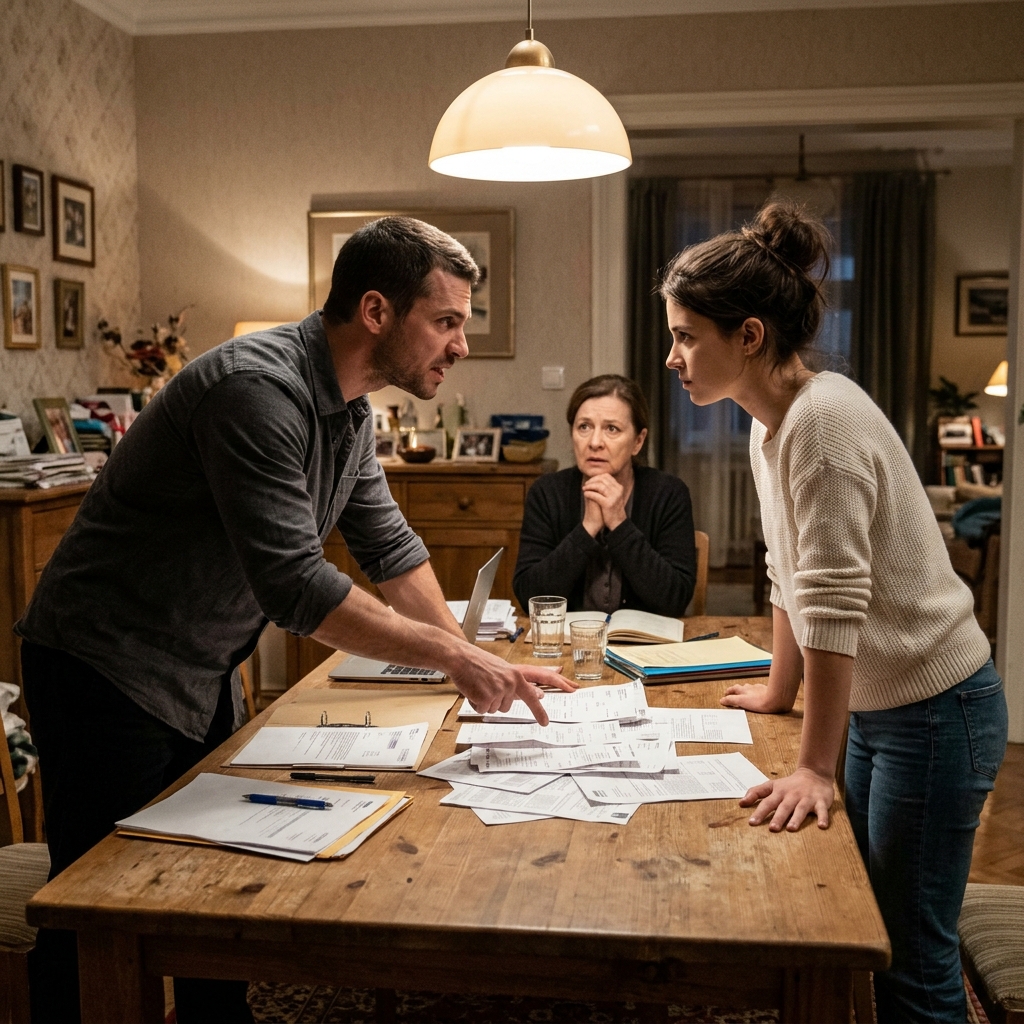
When he asked for money, I asked why.
Usually, he withdrew the request.
Sometimes, he solved the problem himself.
Each solution returned something to him that my rescuing had stolen.
Competence.
By February, he had reduced his debt substantially.
He moved into a small apartment.
It had secondhand furniture.
He complained about the heating.
I told him to buy thicker socks.
He laughed.
Months earlier, I would have called a repair company myself.
Progress can look remarkably unimpressive.
My Norway itinerary remained in a desk drawer.
One evening, I opened it.
The original trip had included Bergen, Flåm, Ålesund, and several quiet days near the fjords.
Malcolm and I had planned Norway twice.
Cancer canceled the first trip.
Grief canceled the second.
A wedding almost canceled it permanently.
I booked a new ticket.
I used money recovered from unused wedding services.
Not all deposits returned.
Enough did.
I chose a departure date in May.
Then I did something difficult.
I told Julian without asking permission.
“I’m going to Norway.”
He smiled.
“Dad would have loved that.”
My body tensed automatically.
Julian saw it.
His smile disappeared.
“Sorry.”
I waited.
He corrected himself.
“You’ve wanted that trip for years.”
I relaxed.
“Yes.”
“You should go.”
“I know.”
We both smiled.
That correction mattered more than he realized.
He had stopped summoning Malcolm to authorize my choices.
In April, Julian asked to meet at the orchard.
I found him beside the old split tree.
He held a small wooden box.
“What is that?”
“Something I should have returned.”
Inside lay Marissa’s engagement ring.
I frowned.
“Why are you giving this to me?”
“Because you paid for it.”
I had forgotten.
Of course I had paid for it.
Another emergency.
Another whispered request.
Another reference to Malcolm.
I closed the box.
“Sell it.”
Julian looked surprised.
“And put the money toward your debt.”
His face fell slightly.
“You don’t want it?”
“I want fewer objects from that wedding.”
He laughed.
“So do I.”
Then he grew serious.
“Mom, can I ask something?”
“Yes.”
“Will you ever trust me again?”
I looked across the orchard.
Trust is an orchard itself.
It takes seasons.
It requires pruning.
It survives weather badly when roots are shallow.
“I trust you more than I did six months ago.”
He absorbed that.
“That isn’t much.”
“No.”
“But it’s something.”
“Yes.”
He nodded.
“I can work with something.”
That was the right answer.
In May, I stood beside a Norwegian fjord beneath a sky wider than any ballroom ceiling.
The water looked like polished steel.
Snow rested on distant mountains.
I carried no wedding emergency phone.
Nobody needed authorization codes.
Nobody demanded imported wine.
Julian sent one message.
It contained a photograph of the orchard irrigation system.
He had repaired it alone.
His caption contained three words.
“Didn’t call you.”
I laughed loudly enough that another traveler glanced over.
I replied with two words.
“I noticed.”
Then I put my phone away.
That evening, I sat outside a small guesthouse watching sunlight linger past dinner.
For years, I had believed love meant preventing people from experiencing consequences.
Malcolm had sometimes warned me about that.
I had ignored him while he lived.
Then I imagined his approval after he died.
Both habits were unfair.
Love was not endless rescue.
Love was not a blank check.
Love was not silence beside somebody who hurt another person.
Love was the freedom to tell the truth and survive what followed.
My cheek had healed months earlier.
The orchard was mine again.
Julian was rebuilding himself without using me as scaffolding.
Marissa had become somebody I no longer checked on.
Victor had become a name my attorney occasionally mentioned.
Bellweather House returned part of my deposit after final accounting.
The property director included a short handwritten note.
“I hope your next celebration belongs entirely to you.”
I kept that note.
Not because the wedding deserved a souvenir.
Because the sentence did.
I returned home in June.
Julian picked me up at the airport.
He drove his old car.
There was no chauffeur.
No rented luxury vehicle.
No flowers waiting in the back seat.
He carried my suitcase without ceremony.
Halfway home, he cleared his throat.
“I made dinner.”
I looked at him.
“You cook now?”
“I possess a fire extinguisher.”
I laughed.
“That was not my question.”
“I’m learning.”
We reached the orchard near sunset.
He had prepared dinner outside the old shed.
Two plates.
Two glasses.
A supermarket bottle of sparkling cider.
I picked it up.
“How much?”
“Seven dollars.”
“Extravagant.”
“I had a coupon.”
I laughed until tears came.
Julian started laughing too.
Then both of us became quiet.
Malcolm’s tree stood nearby.
Wind moved softly through its branches.
Julian raised his glass.
He hesitated before speaking.
I watched him carefully.
“To second chances?”